Surely these are legitimate concerns, and Islamic scholarship still exists, and will continue to (although sometimes it seems like we are fighting tooth and nail). However, there is a lack of scholarship which responds to the aforementioned concerns. Collectively, the 'ulama's elitism and failure to engage with secular-modernity, western/capitalist encroachment has partly contributed to the marginalization of Muslims societies. There is a dire need for the production of such scholars who not only respond to the challenges listed, but also approach them from within the Islamic tradition.
Saturday, June 13, 2015
Ghurabaa' (Strangers)
The more I grow in intellect, the more comfort I find in the following hadith: "Islam began as something strange, and it will return to being strange, so blessed are the strangers." A crisis of Islamic scholarship exists when we attempt to speak from tradition, yet still use the intellectual framework that comes with secularity. For example: how does the enlightenment notion of progress hold any merit in the Islamic tradition? Why is 'x' or 'y' practice/way of thinking derided because it is not contemporary? Why is modernity the yardstick to measure success? How does a belief in the modern ethos alter 1400+ years of legitimate Islamic scholarship?

Tuesday, March 10, 2015
Learning Religion from Cuba
Abu Shariati of the blog recently had the chance to travel to Cuba for an exciting workshop on transformative education. The following are some of his thoughts on the expressions of religion embodied in social change:
Imagine a world without the need to incessantly recycle a plethora of hackneyed, overdone discursive binaries and clichés that dumb down intelligent discussion rather than enhance it. It was the author’s unique honor to experience such a world – or something closely approximating it – on my recent trip to that embargoed, but incredibly vibrant and revolutionary, island of Cuba. My amateurish reflections, however, are not merely of Cuban society, but of Latin America in general. It was a gathering of theologians and religious intellectuals, thinkers, and activists from across the world, but with the Latin American flavor of religion writ large on it.
While the attendees may be characterized as the more progressive sections of ‘the Church,’ there was clearly an entirely novel paradigm of ‘doing religion’ that would seem alien to liberals in Pakistan. What was so remarkable is that the discourse we were exposed to would translate into a standard progressive narrative in Pakistan and most parts of the Muslim world – the latter not only being not religious, but at times anti-religion. YET, the Latin American progressives and revolutionaries have not thrown the baby out with the bathwater.What was striking in my conversations and deeper reading of this part of the world, is that those that heavily invoked religion are usually the ones who are most zealously on the side of progressive social change.
The largest churches in the country that were hosting some spectacular events of solidarity and support for issues like socio-economic and gender justice, as well as resistance to forms of neo-colonialism in the region. The expressions of religion were prophetic in all ways, not only speaking truth to power, but concretely challenging it. The Cuban and Latin American experience reminds us – though of course I’m not sure if we need this reminding in the Muslim world! – that religion continues to play a significant role in many if not most societies of the world. If there is a meaningful solution to violent extremism, this is it. The sooner we learn that in Pakistan, the better.
Tuesday, January 27, 2015
On the anniversary of Howard Zinn's passing
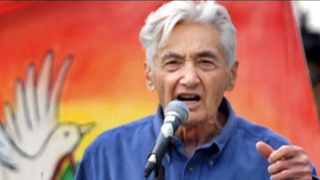
I threw out all my US history textbooks and listened to this guy. Let us remember his emphasis on the importance of historicizing through a people's perspective. What is truly remarkable about Zinn's work, from an Islamic perspective, is his documentation of Muslim involvement in slavery, civil rights, and black liberation/power eras...putting to bed the highly toxic/racist stereotype of the model minority Muslim which perpetuates anti-black/latino/a racism, US exceptionalism, and class patronage! Islam is not acquiescent to the iron fist or the crown (shoutout to House of Saud). Islam is political. Islam is transformative. Islam is justice.
Subscribe to:
Posts (Atom)